
Programmes
- Format
- Part-time, remote5–20 hours per week
- Length
- 3 monthsplus an optional extension
- Teams
- Small teamswith an expert mentor
- Tracks
- Technical AI SafetyTechnical AI GovernanceAI Governance & PolicyCommunication & Fieldbuilding
Spring 2026 cohort
27th Apr – 31st Jul 2026
226applications
73mentees
22projects
74%
of mentees would not have worked on AI safety without SAIGE.
Survey of 50 of 73 mentees, Spring 2026 Incubator cohort.
Research highlights
- NeurIPS 2026Workshop paperOral presentationBenchmarking Exploration Hacking Propensity in Frontier LLMsEduard Hübner · team mentored by Joschka Braun
- NeurIPS 2026Workshop paperPosterStress-Testing RL-based Capability Elicitation with Randomized UnderperformanceNina Zukowska · team mentored by Joschka Braun
- NeurIPS 2026AI4GOOD WorkshopOral presentationLearning Steganography Is Easy, Learning Steganographic Reasoning Is HardLukas Fülle, Rieke Fruengel · team mentored by Julian Schulz
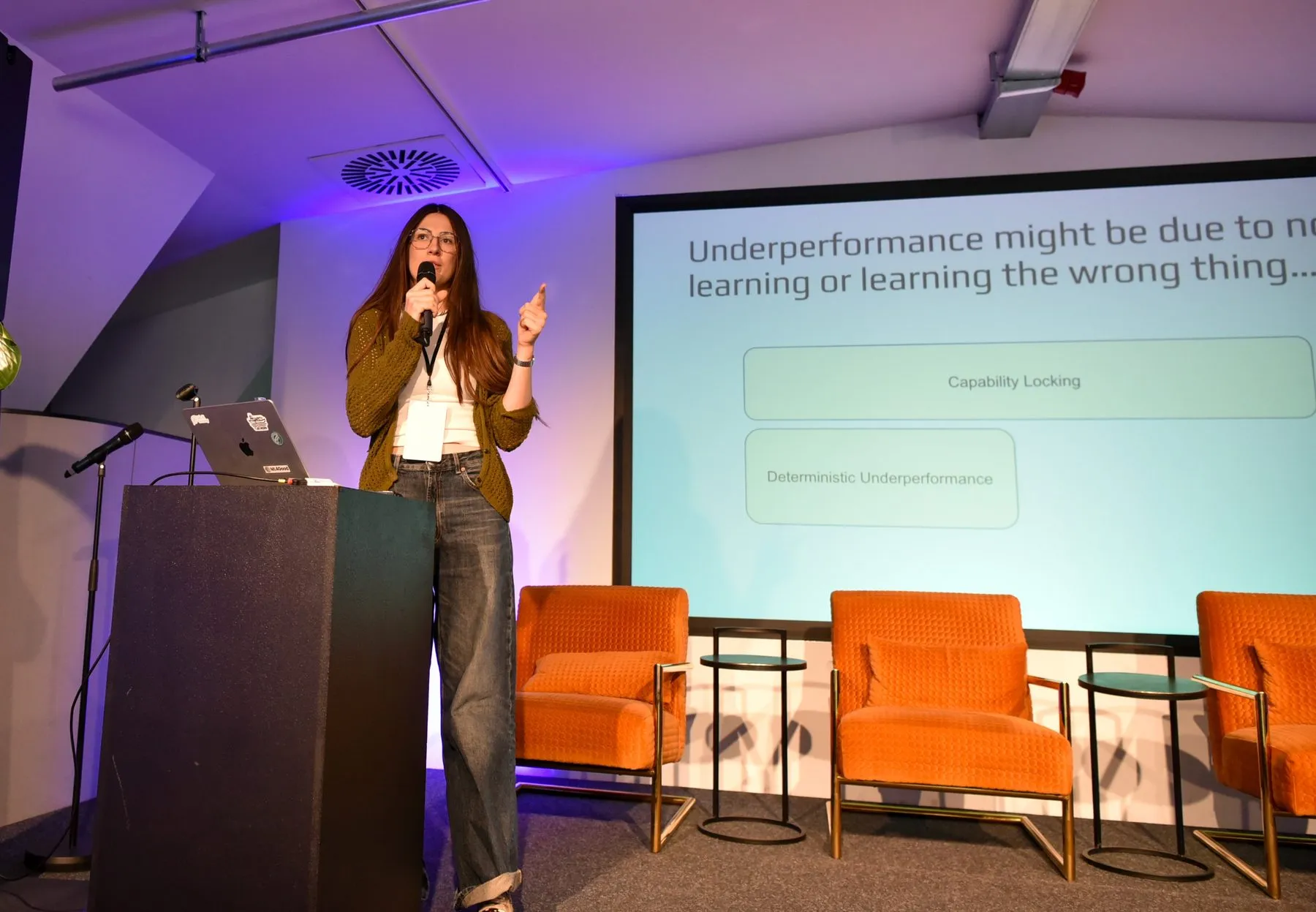
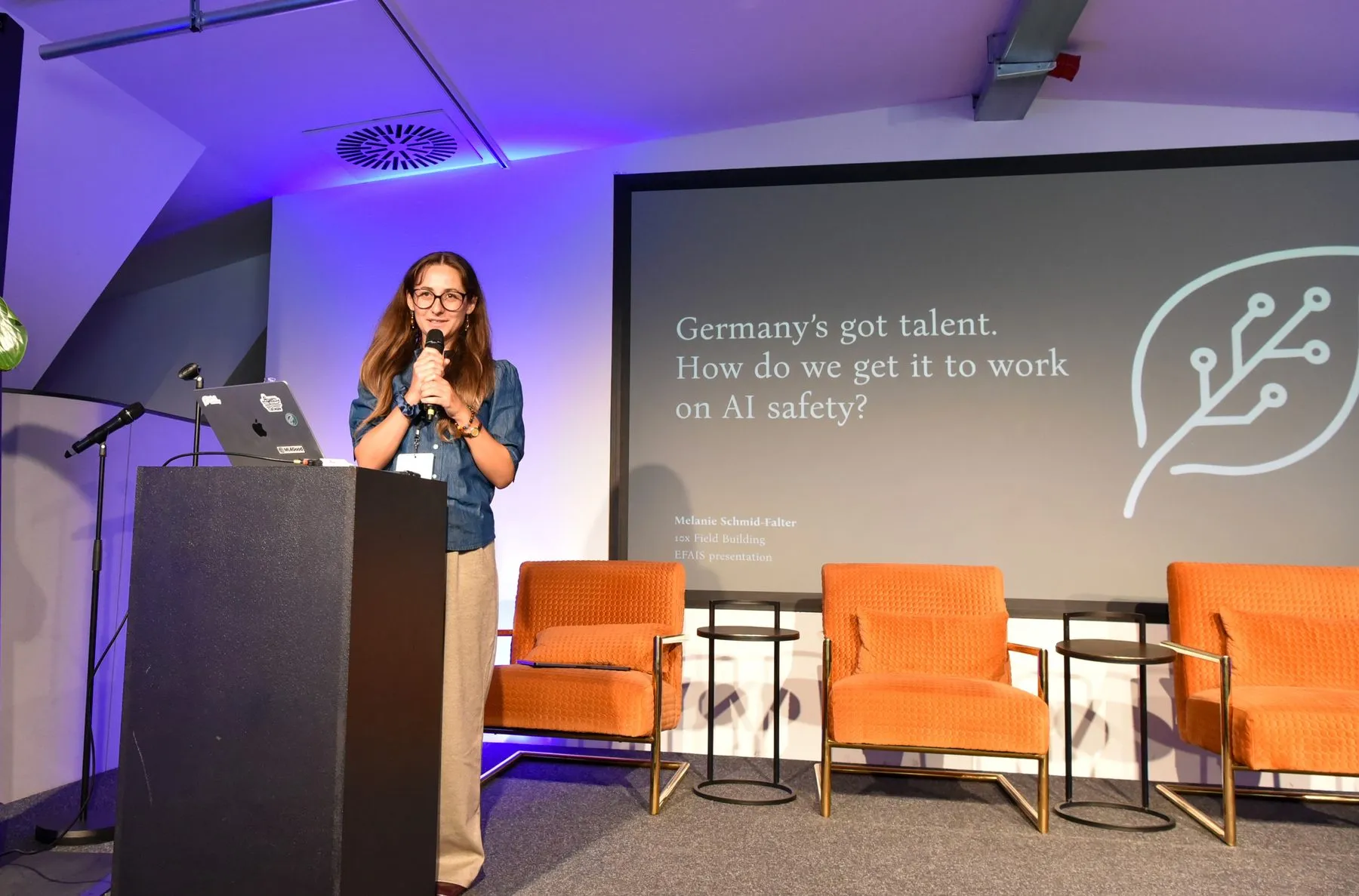
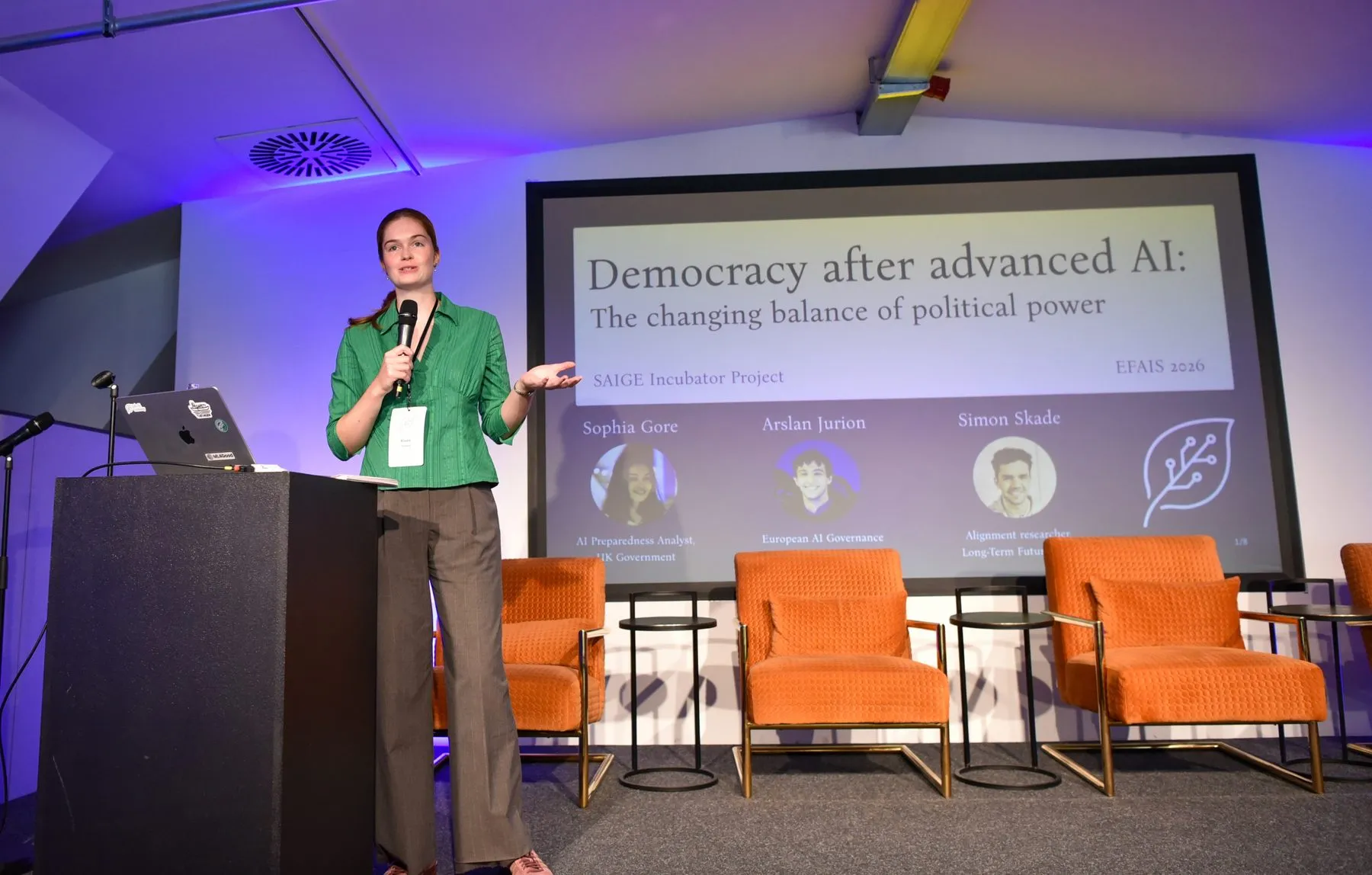
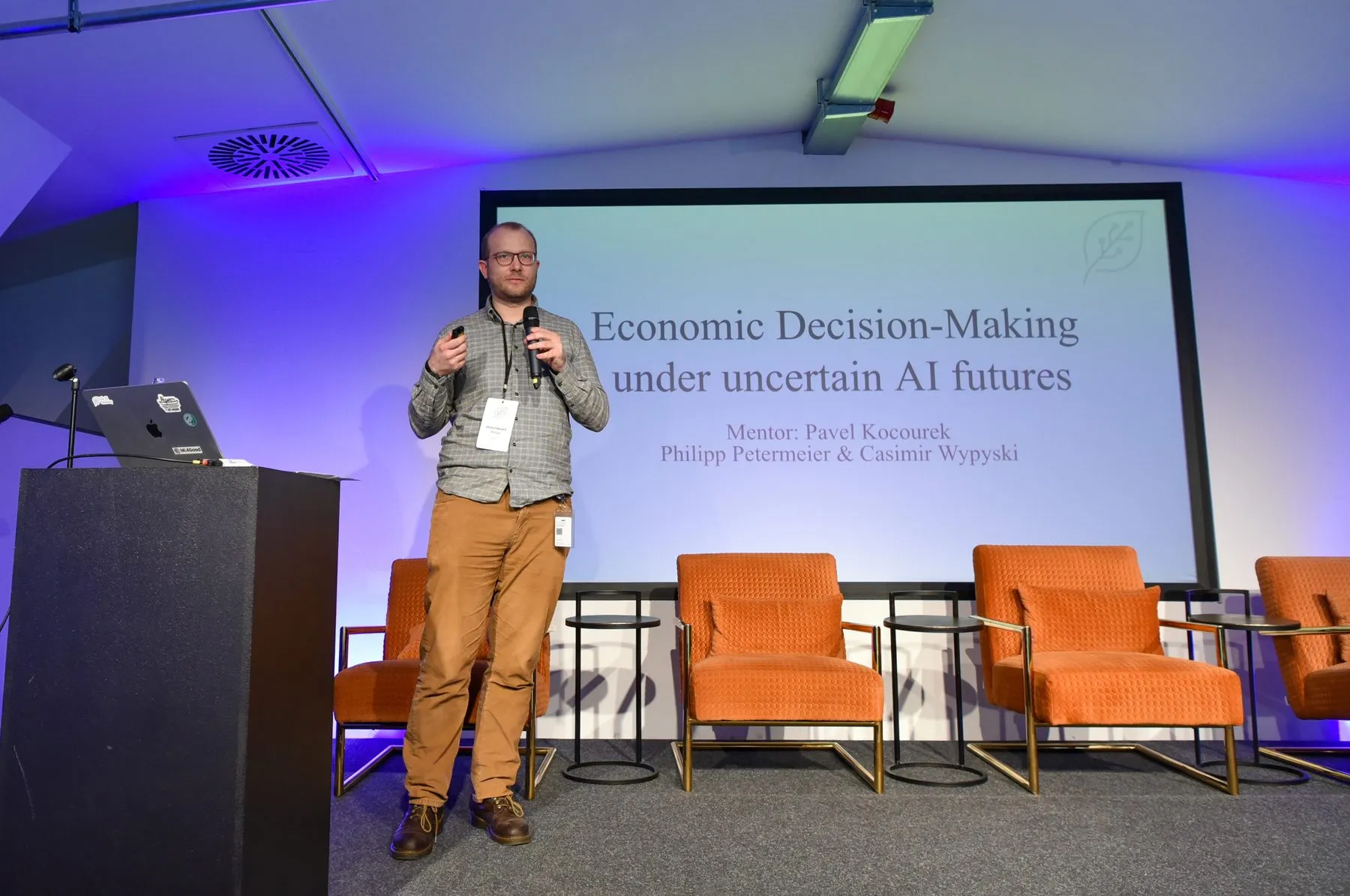
Project showcase at EFAIS 2026
Projects
Communication & Fieldbuilding5 projects
- Digital Minds PrimerJulia Bossmann, Director of Research & Strategy, Sentient Futures
- Fellowship Navigator: A Decision Tool for Career TransitionMarta Krzeminska, Program Operations Lead, Future Impact Group
- Visualizing AI Safety Risks for German Decision MakersInken Paland, Founder & Content Strategist, Independent
- New Fieldbuilding Organisations in GermanyTilman Räuker, Co-director, Pivotal Research
- Raising Awareness for AI Existential Risks in GermanyKarl von Wendt, Writer and YouTuber, Independent
AI Governance & Policy5 projects
- Convergence or Divergence? The Future of Frontier AI Capabilities and Implications for Catastrophic RiskPavel Kocourek, Postdoctoral Fellow, University of Duisburg-Essen
- Economic Decision-Making Under Deep Uncertainty About AI’s TrajectoryPavel Kocourek, Postdoctoral Fellow, University of Duisburg-Essen
- Estimating AI Harm Rates for Germany: Applying Epidemiological Methods to Incident MonitoringBranwen Nia Owen, Research Fellow, Arcadia Impact
- Improving the Deutschland-Stack’s Approach to AI Procurement and AccessChris Schmitz, Research Associate, Hertie School
- How Will AI Affect the Democracy Equilibrium?Simon Skade, Co-lead, PauseAI; independent AI alignment researcher
Technical AI Governance3 projects
- Verification of a Global AI TreatyNaci Cankaya, Technical AI Governance Researcher, Machine Intelligence Research Institute
- Risk-Weighted Compute Permits Under Imperfect Monitoring: Enforcement Design and an EU-Implementable BlueprintJoel Christoph, Harvard Kennedy School
- Stanford SAFE: Designing Interactive Modules to Introduce High-Ranking Decision Makers to Technical AI FundamentalsFelix Krückel and Duncan Eddy, Stanford Center for AI Safety, RWTH Aachen; Stanford University
Technical AI Safety9 projects
- Empirical Technical AI Safety ResearchJoschka Braun, Research Fellow, MATS
- Inoculation Against Model PoisoningFlorian Dietz, Independent researcher
- Advancing the Human Empowerment Approach to Safe AI AgentsJobst Heitzig, Zuse Institute Berlin and Potsdam Institute for Climate Impact Research
- A Meta-Analysis of the AI Safety Research LandscapeIhor Kendiukhov, CEO, Theomachia Labs
- A Benchmark for Preventing Emergent MisalignmentFlorian Mai, Junior Research Group Leader, University of Bonn
- Outcome-Based Distillation for Jailbreaking Safety GuardrailsAlexander Panfilov, MATS and ELLIS Institute Tübingen
- Fungal InterpretabilityLukas Galke Poech, Assistant Professor, University of Southern Denmark
- Detecting and Mitigating Language-Triggered Value Instability in Multilingual LLMsAjay Mandyam Rangarajan, Jeyashree Krishnan and Jason Hoelscher-Obermaier, Apart Research
- Eliciting Encoded Reasoning in Language Models Trained Against Chain-of-Thought MonitorsJulian Schulz, Meridian Research
From people who took part
“The SAIGE incubator gave me the experience and skills I needed to transition into the field full-time. My mentor provided invaluable ideas and challenges throughout the project, and helped me grow my network.”
Sophia GoreAnalyst, Department for Business, Innovation, Science and Trade (UK Civil Service)
“My team and mentor shared my motivation to make AI risks tangible for a general audience. It feels empowering to go from ‘worried’ to ‘working on it.’”
Dr. Michael BonfertSAIGE Mentee
“I’ve been very impressed by the mentees I’ve worked with through SAIGE. Both submissions were accepted to NeurIPS workshops, with one selected for an oral presentation.”
Joschka BraunResearch Scientist, Apollo Research; SAIGE Mentor
“SAIGE was the main reason why I have decided to pivot to AI Safety two years earlier than I had originally planned: It was the perfect part-time experiment to test whether I might enjoy working in AI safety.”
Aleksandra ShcherbakovaResearch Assistant, LawAI
“SAIGE is doing the long-overdue work of connecting talented people across AI safety and governance in Germany.”
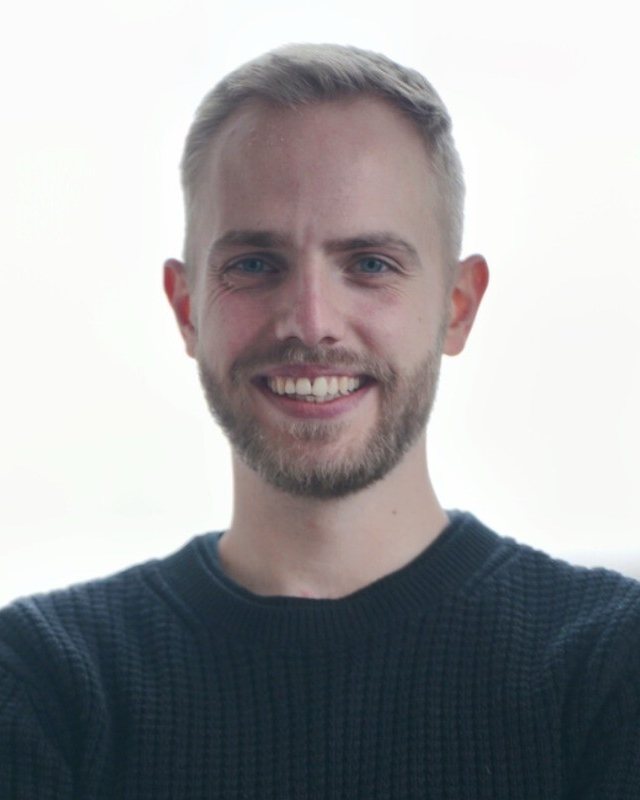
Chris SchmitzResearch Associate, Hertie School (ex-GovAI Fellow)